Sunday, November 1, 2026

The best way to handle low stock alerts on Shopify

autoStockist

```html

Efficient inventory management is the backbone of any successful eCommerce business. For Shopify merchants, navigating the complexities of stock levels can often feel like a juggling act. One misstep, and you might find yourself facing stockouts, lost sales, and frustrated customers. This is where low stock alerts come into play, serving as a safeguard against the pitfalls of poor inventory management.

Understanding Low Stock Alerts

Low stock alerts are notifications that inform you when your inventory levels for specific products fall below a predetermined threshold. These alerts are vital for maintaining optimal stock levels, ensuring that you can meet customer demand without overcommitting your resources. For Shopify merchants, this translates to fewer missed sales opportunities and a more streamlined operation.

However, many merchants grapple with issues related to stock management. Manual inventory checks can be laborious and error-prone, leading to inconsistent stock levels. As your business grows, the sheer volume of products can make it increasingly difficult to keep track of everything. A well-implemented low stock alert system can save the day by providing timely notifications that help you stay ahead of potential stockouts.

The Role of Automation in Inventory Management

Automating stock alerts can significantly ease the burden of manual checks. Imagine waking up to a simple email or an app notification that tells you exactly what needs restocking. Automation not only saves time but also reduces the chances of human error. With an effective system in place, you can focus on other critical aspects of your business, such as marketing and customer service.

This proactive approach allows you to set alerts that notify you when it’s time to reorder, ensuring that your customers always find what they need when they visit your store. Automation can transform the way you approach inventory management, making it a more efficient and less stressful process.

Key Features to Look for in Stock Alert Tools

Not all stock alert systems are created equal. When searching for an inventory management tool, consider the following key features:

  • Actionable Alerts: Look for alerts that provide clear actions. A notification saying “Product X is low” is less helpful than one that suggests “Restock Product X now; current stock is only 5.”
  • Predictive Analytics: Tools that use data to forecast demand can be invaluable. By analyzing past sales, these systems can suggest when to reorder based on predicted sales trends.
  • Customization Options: Every business is different. Ensure that the tool allows you to set custom thresholds for low stock alerts based on the sales velocity of individual products.
  • Integration with Your Existing Systems: The tool should seamlessly integrate with Shopify and any other systems you use, such as accounting or logistics software.

Introducing autoStockist

For Shopify merchants seeking an effective solution, autoStockist offers a robust inventory management tool designed specifically for the Shopify ecosystem. Built by a solo developer, autoStockist focuses on reducing repetitive inventory monitoring while providing actionable insights that help merchants manage their stock levels more effectively.

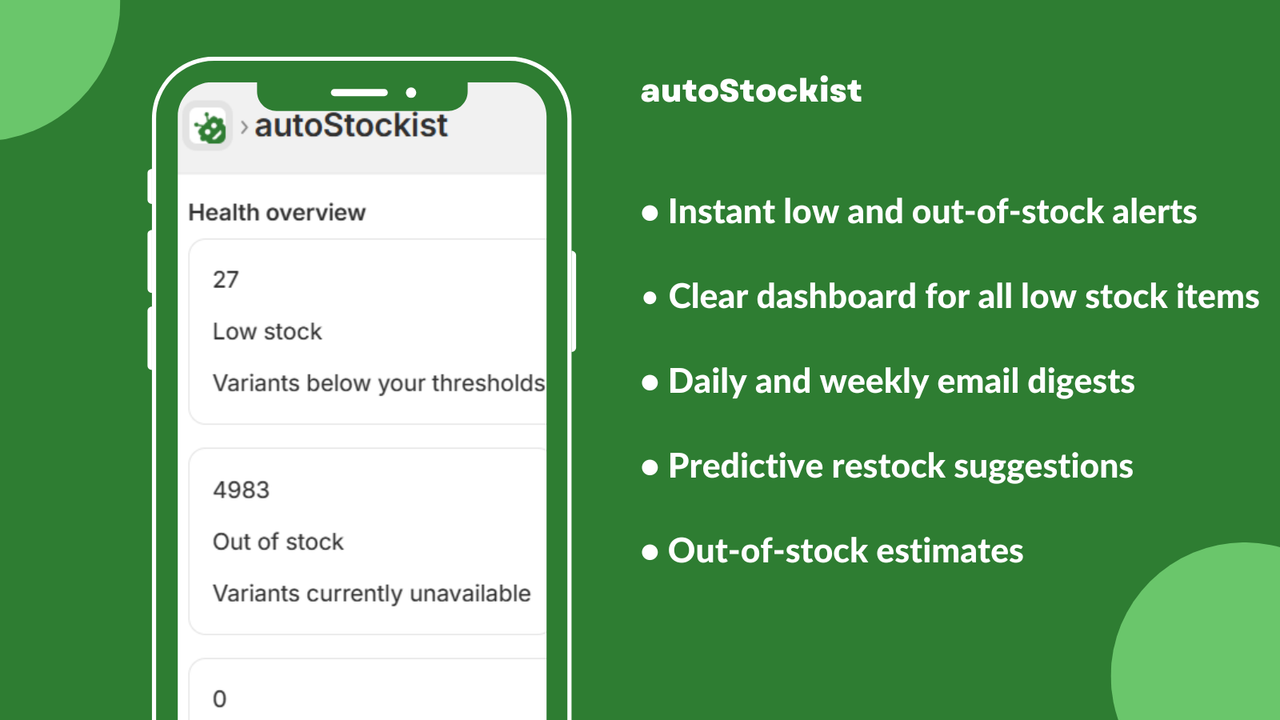
The app features low stock and out-of-stock alerts, an inventory monitoring dashboard, and even predictive restock suggestions based on recent sales activity. This means you can receive timely notifications about what to reorder and when, helping you maintain optimal stock levels without the constant manual checking.

Practical Steps to Set Up Low Stock Alerts on Shopify

Setting up low stock alerts in Shopify with autoStockist is straightforward. Here’s a step-by-step guide:

  1. Install the app: Begin by adding autoStockist to your Shopify store through the Shopify App Store.
  2. Configure your settings: Once installed, navigate to the settings section of the app. Here, you can set your low stock thresholds for various products. Consider factors like sales velocity and supplier lead times when determining these thresholds.
  3. Enable notifications: Choose how you want to receive alerts — via email or through the app. Make sure your contact details are up to date to avoid missing any important notifications.
  4. Regularly review your settings: As your product lines or sales patterns change, revisit your low stock thresholds to ensure they still reflect your business needs.

Real-Life Scenarios and Case Studies

Let’s consider a fictional Shopify merchant, Lucy, who runs a small online boutique selling handmade crafts. Before implementing low stock alerts, Lucy often faced stockouts of her popular candle line. She would receive customer complaints about unavailable products, leading to lost sales and a tarnished reputation.

After integrating autoStockist, Lucy set low stock alerts based on her sales data. Now, whenever her candle stock dips below ten units, she receives a clear notification that prompts her to reorder. This proactive approach not only improved her inventory management but also boosted her customer satisfaction, as her products were consistently in stock.

Trade-offs and Limitations

While automated systems like autoStockist significantly improve inventory management, they are not without their trade-offs. Relying solely on automated alerts can lead to complacency. Merchants should still conduct periodic manual inventory reviews to catch any discrepancies or errors that automated systems might not highlight.

Additionally, while predictive analytics can aid in planning, they are not infallible. Market trends can shift unexpectedly, and customer preferences can change. Thus, it’s essential to complement automated tools with regular market research and customer feedback to ensure your inventory strategy remains effective.

Common Mistakes and Misconceptions

Many merchants mistakenly believe that all stock alerts are created equal. However, without customization, alerts can become noise rather than a useful tool. Setting generic thresholds may not reflect your unique sales patterns, leading to either excessive stock or stockouts.

Another common misconception is that low stock alerts will automatically lead to improved sales. While they are a critical component of effective inventory management, they must be part of a broader strategy that includes robust restocking processes and supplier relationships. Understanding the nuances of your inventory and customer behavior is essential for maximizing the benefits of low stock alerts.

Conclusion

Effective management of low stock alerts is essential for Shopify merchants aiming to maintain inventory levels, avoid stockouts, and enhance customer satisfaction. By implementing a reliable system like autoStockist, you can reduce the hassle of constant stock monitoring and focus on growing your business. Don’t let poor stock management hinder your success; consider exploring automated solutions that can streamline your operations and keep your customers happy.

FAQ

What are low stock alerts, and why are they important?

Low stock alerts notify you when your inventory levels for specific products fall below a set threshold, helping you avoid stockouts and ensuring you meet customer demand.

How does autoStockist differ from other inventory management tools?

autoStockist is tailored specifically for Shopify, offering actionable alerts, predictive analytics, and easy integration, all designed to simplify inventory management for merchants.

Can I customize the thresholds for low stock alerts in autoStockist?

Yes, autoStockist allows you to set custom low stock thresholds based on the sales velocity of individual products, ensuring that alerts are relevant to your business needs.

How often should I review my inventory and alert settings?

It’s advisable to review your inventory and alert settings regularly, especially when introducing new products or during seasonal sales, to ensure they reflect current trends and sales patterns.

What should I do when I receive a low stock alert?

When you receive a low stock alert, assess the product’s sales velocity and supplier lead times, then reorder the product as necessary to avoid stockouts and maintain customer satisfaction.

```

About the app: I build and support autoStockist independently. If the problem discussed in this article sounds familiar, you can see the app and its current features on the Shopify App Store.
autoStockist


Labels:

Friday, October 30, 2026

Unlocking E-Commerce Success: How Personalized Recommendations Drive Sales

a computer screen with a rocket on top of it
Photo by Growtika on Unsplash

The Impact of Personalized Product Recommendations on E-Commerce Conversion Rates

Let’s be honest: online shopping can sometimes feel like wandering through a massive maze with no cheese at the end. You know there’s something good out there, but finding it can resemble a Herculean task. Enter personalized product recommendations — the magical breadcrumbs that lead us to the treasure trove of products tailored just for us. But how do these recommendations really affect e-commerce conversion rates? Buckle up, dear reader, as we dive into this winding path of data, psychology, and a sprinkle of humor!

What Are Personalized Product Recommendations?

First off, let’s clear the air. Personalized product recommendations are like your wise, well-meaning friend who nudges you towards that fabulous outfit you didn’t even know you needed. They are tailored suggestions based on your previous behavior, preferences, and sometimes, your deepest shopping desires (okay, maybe not that intense). These recommendations can appear in various forms:

  • “Customers who bought this also bought…”
  • “Recommended for you” sections
  • Emails tailored to your browsing history
  • Retargeting ads that follow you around like a lost puppy

At its core, personalized recommendations aim to enhance the shopping experience by making it feel less like a chaotic free-for-all and more like a curated selection of items just for you. But how effective are they? Let’s dive into the numbers!

The Data Behind the Magic

Research has shown that personalized recommendations significantly boost conversion rates. In fact, according to a study by McKinsey, personalized recommendations can lead to a 10–30% increase in sales for e-commerce businesses. That’s not just a small bump; that’s like finding a five-dollar bill in your old winter coat — unexpected and delightful!

So, what’s happening here? It turns out, personalized recommendations tap into the psychological principle of social proof. When customers see products that others have purchased or that align with their interests, they feel more confident in their buying decisions. It’s like having a friend say, “Trust me, you need this. I have it, and it’s amazing!”

How Personalized Recommendations Influence Shopping Behavior

Let’s break down the ways personalized recommendations can turn a casual browser into a committed buyer:

1. Improved User Experience

Imagine walking into a store where the sales associate knows your taste, size, and favorite color. Sounds dreamy, right? Personalized recommendations create a similar experience online. By showing products that align with a shopper’s interests, e-commerce sites can make the buying process smoother and more enjoyable. Less scrolling, more finding!

2. Increased Engagement

Personalized recommendations keep customers engaged. When shoppers see items that catch their eye, they’re more likely to click around, explore, and ultimately, add items to their cart. It’s like a rabbit hole of delightful discoveries! And the longer they stay on the site, the higher the chances of conversion. Just remember, this isn’t an endless Netflix binge; you want them to actually buy something!

3. Building Customer Loyalty

When customers feel understood and catered to, they’re more likely to return. A positive shopping experience fosters loyalty, and loyal customers are like gold — especially when it comes to e-commerce. Personalized recommendations can make consumers feel valued, and when they feel valued, they’re more likely to hit that “Buy Now” button like it’s the last slice of pizza at a party.

4. Higher Average Order Value

You’ve heard the phrase “You can’t eat just one,” right? Well, the same goes for online shopping! Personalized recommendations can encourage customers to buy more items. Think about it: if they’re already considering a pair of shoes, and the site suggests a matching handbag, they may just end up with both! This technique can significantly increase the average order value (AOV) and make your bank account smile.

Implementing Personalized Recommendations: The How-To

So how can e-commerce businesses harness the power of personalized recommendations? Here are some strategies:

1. Use Data Analytics

To effectively personalize recommendations, you need data — lots of it! Analyzing customer behavior, preferences, and purchase history is crucial. Many e-commerce platforms offer built-in analytics tools, but you can supercharge your efforts with apps like autoBlogger, which helps streamline your content marketing while providing insights into customer preferences.

2. Leverage Machine Learning

Machine learning algorithms can analyze vast amounts of data to identify patterns and deliver personalized recommendations. These smart tools learn from each interaction, improving over time and becoming more effective at predicting what customers want. Who knew machines could be so insightful?

3. A/B Testing

Not every recommendation strategy will work for every business. A/B testing allows you to experiment with different approaches and see what resonates best with your audience. It’s like finding out if your friend prefers chocolate or vanilla ice cream; you won’t know until you ask (or try both!).

4. Keep it Simple

While it’s great to have personalized recommendations, too many options can overwhelm customers. Instead of bombarding them with every possible item, curate a selection that feels manageable. Think of it like a well-edited movie trailer — just enough to whet their appetite!

Challenges of Personalized Recommendations

Before you get too excited and start throwing recommendations at every corner, let’s talk about some challenges:

1. Privacy Concerns

Customers today are more aware of their data privacy. If your recommendations feel too intrusive, it might backfire. Remember to be transparent about how you’re using their data and give them control over their preferences. No one likes a creepy stalker, even when it comes to shopping.

2. Misguided Recommendations

Sometimes, the algorithms can miss the mark, suggesting items that are way off base. Picture someone who regularly buys workout gear being recommended a donut-making kit. While it might be a delicious distraction, it’s not exactly what they signed up for. The key is to continuously refine your algorithms to ensure they’re hitting the right notes.

3. Over-Reliance on Automation

While automation can streamline processes, it’s essential to maintain a human touch. Sometimes, a personal recommendation from a customer service representative can go a long way. Don’t let the robots take over completely; after all, they’re still figuring out how to make a decent cup of coffee!

Final Thoughts

In the grand scheme of e-commerce, personalized product recommendations have proven to be a game-changer. By enhancing user experience, boosting customer engagement, and increasing sales, they have become an indispensable tool for online retailers. So, next time you’re lost in the labyrinth of online shopping, remember that those little nudge-worthy recommendations are there to guide you home.

Whether you’re a small business owner or a seasoned e-commerce veteran, investing in personalized recommendations can pay off big time. And for those looking to streamline their content marketing and gain deeper insights into customer behavior, don’t forget to check out autoBlogger. It’s like having a trusty sidekick in your e-commerce journey!

Note, this article was written with AI assistance to improve readability and give you, the reader, a better experience! :)


Labels:

Sunday, October 25, 2026

Why Shopify Stores Struggle with JSON-LD Structured Data

autoSchema

```html

In the competitive world of ecommerce, visibility is crucial. For Shopify merchants, structured data plays a vital role in enhancing search visibility and helping potential customers discover their products. However, many merchants grapple with the intricacies of JSON-LD structured data, leading to frustration and missed opportunities. This article will explore the challenges Shopify stores face with JSON-LD, the importance of maintaining clean structured data, and how automation tools like autoSchema can simplify the process.

Understanding JSON-LD Structured Data

JSON-LD stands for JavaScript Object Notation for Linked Data. It is a method of encoding linked data using JSON. For Shopify merchants, JSON-LD is crucial because it helps search engines better understand the content on their sites, which can lead to enhanced search results, such as rich snippets that showcase product details directly in search results.

In essence, JSON-LD allows merchants to provide structured information about their products, reviews, and more, in a way that search engines can easily interpret. This includes everything from product prices and availability to customer reviews and ratings. By implementing JSON-LD, merchants essentially provide search engines with a “cheat sheet” about their stores, improving the chances of displaying their products effectively.

Common Challenges with JSON-LD in Shopify

While the benefits of structured data are clear, implementing it can be daunting for many Shopify merchants. Here are some common challenges they face:

  • Lack of Technical Expertise: Many merchants do not have a technical background, making it difficult to implement structured data correctly. The idea of coding can be intimidating, especially when they are focused on running their stores.
  • Duplicate and Conflicting Schema: As stores grow, it is not uncommon to end up with duplicate structured data or conflicting schema, which can confuse search engines and negatively impact visibility.
  • Maintaining Structured Data: Keeping structured data updated as inventory changes or new products are added can be overwhelming, particularly without a robust understanding of JSON-LD.

These challenges can lead to significant missed opportunities. If structured data is not set up correctly, merchants might miss out on rich snippets that could make their products stand out in search results. Instead of attracting potential customers, their listings may get lost among competitors.

The Importance of Clean and Accurate Structured Data

Structured data is often viewed as a tool to boost SEO, but it serves a more significant purpose. Clean and accurate structured data is essential not only for search visibility but also for providing a better user experience. When search engines can accurately interpret data, they can serve it to users in meaningful ways.

However, misconceptions can lead to mistakes. Some merchants believe that simply adding more structured data is beneficial. In reality, quality trumps quantity. It is crucial to provide accurate representations of products rather than attempting to include every piece of data imaginable. Excessive or incorrect structured data can lead to penalties from search engines.

Automating Structured Data Management

Given these challenges, automation can be a lifesaver. This is where tools like autoSchema come into play. Designed specifically for Shopify stores, autoSchema automates the process of adding and maintaining structured data, allowing merchants to focus on what they do best — running their businesses.

With features like one-click structured data setup and automatic updates as stores change, autoSchema helps avoid the headaches associated with manual management. It works seamlessly with existing Shopify themes and requires no coding knowledge, making it accessible for everyone, regardless of their technical skills.

Best Practices for Managing Structured Data

Even with automation, there are best practices to keep in mind for managing structured data effectively:

  • Regular Checks: Make it a habit to audit structured data periodically. This helps catch any duplicates or conflicts early on.
  • Stay Informed: Keep up-to-date with changes in schema guidelines and best practices from search engines.
  • Monitor Changes: As stores evolve — whether adding new products or changing existing ones — ensure structured data is updated accordingly.

By following these practices, merchants can maintain clean and accurate structured data that benefits both search visibility and user experience.

Real-World Scenarios

To illustrate the importance of structured data management, consider the following scenarios:

Imagine a merchant with a growing inventory who initially set up structured data manually. As new products were added, they forgot to update the schema. Consequently, some products were missing vital information in search results, leading to a drop in click-through rates. Once they implemented autoSchema, the automatic updates ensured their structured data was always accurate, resulting in improved visibility.

In another case, a store that did not monitor its structured data ended up with duplicate schema due to multiple apps adding their own structured data. This led to confusion for search engines and ultimately penalties, reducing their visibility. After resolving the conflicts and implementing a more systematic approach with autoSchema, they regained their standing in search results.

Trade-offs and Limitations

While automation tools like autoSchema offer significant benefits, it is essential to acknowledge their limitations. Automation cannot guarantee rich results in search engines, as these are ultimately controlled by the search engines themselves. Over-reliance on automation may lead to a lack of understanding of structured data principles, which is crucial for effective management.

Furthermore, it is vital to remember that structured data requires ongoing maintenance. Having a tool in place does not mean merchants can set it and forget it. Regular audits and updates are still necessary to ensure structured data remains relevant and accurate.

Common Mistakes or Misconceptions

Many merchants fall into traps when it comes to structured data. Here are a few common misconceptions:

  • Believing that more structured data is always better can lead to penalties. Focus on quality and accuracy.
  • Assuming that once structured data is implemented, it does not require ongoing maintenance can result in outdated or incorrect information.
  • Confusing JSON-LD with other structured data formats can lead to implementation errors. Understanding the nuances of JSON-LD is vital for effective use.

Practical Steps or Checks

To ensure structured data is on point, consider these practical steps:

  • Use a structured data testing tool (like Google’s Structured Data Testing Tool) to audit existing structured data.
  • Implement autoSchema effectively by following the setup instructions and ensuring it aligns with your store’s needs.
  • Schedule regular maintenance checks to ensure structured data remains clean and accurate.

FAQ

  • What is JSON-LD and why is it important for my Shopify store?
    JSON-LD is a method of encoding linked data for search engines, allowing them to better understand your content. This can enhance your visibility in search results.
  • How can I check if my structured data is implemented correctly?
    You can use tools like Google’s Structured Data Testing Tool to check your structured data for errors and ensure it is set up correctly.
  • What are the consequences of having duplicate or conflicting structured data?
    Duplicate or conflicting structured data can confuse search engines, potentially leading to penalties and reduced visibility in search results.
  • Can I use autoSchema if I have a custom Shopify theme?
    Yes, autoSchema is designed to work with existing Shopify themes, making it compatible even if you have a custom setup.
  • Does implementing structured data guarantee rich snippets in search results?
    No, while structured data can improve the chances of obtaining rich snippets, the final decision lies with the search engines.

Conclusion

Managing JSON-LD structured data is essential for Shopify merchants aiming to enhance their SEO efforts and improve their store’s visibility. While the challenges can seem overwhelming, understanding the importance of clean and accurate structured data is the first step toward overcoming them. Tools like autoSchema can significantly simplify the process, allowing merchants to automate maintenance while focusing on their core business activities. By remaining informed about structured data and adopting best practices, Shopify merchants can navigate the complexities of structured data effectively, leading to better search visibility and ultimately more sales.

```

About the app: I build and support autoSchema independently. If the problem discussed in this article sounds familiar, you can see the app and its current features on the Shopify App Store.

autoSchema


Labels:

Thursday, October 22, 2026

Discover the Harmony of Multi-Store Management with Storechestra

store image

Welcome to Storechestra, a delightful haven for businesses managing multiple Shopify stores. If you’ve ever felt overwhelmed by juggling several platforms, you’re not alone! Storechestra brings all your sales, orders, and inventory into one beautifully clear command center. Imagine sipping your coffee while effortlessly overseeing every aspect of your online shops, all from a single dashboard. It’s not just about efficiency; it’s about peace of mind.

A Dashboard Designed for Ease

Picture a workspace where everything is perfectly in sync. Storechestra offers a user-friendly interface that makes managing everything from orders to customer interactions seamless. No more fumbling between different store tabs — this platform allows you to connect all your stores and view their performance live. It’s like having a personal assistant who knows your business inside and out.

  • All your data in one place: Keep track of sales, customers, inventory, and more with just a few clicks.
  • Analytics at your fingertips: Gain valuable insights that help you make informed decisions quickly.
  • Customizable views: Tailor your dashboard to focus on what matters most to you and your team.

Built for Shopify Teams

Storechestra is crafted with the unique needs of multi-store operators in mind. Whether you manage two stores or a dozen, this platform scales with you. It’s designed to keep each store’s identity intact while simplifying your overall management process.

Streamlined Operations

Some of Storechestra’s standout features include:

  • Order Management: Effortlessly handle orders across all your stores from one unified interface. Say goodbye to double entries!
  • Inventory Oversight: Keep tabs on your stock levels across multiple locations, helping you avoid the dreaded “out of stock” notifications.
  • Customer Management: Enhance customer satisfaction by easily tracking engagement and providing personalized experiences.

Innovative Solutions for Modern Merchants

In the fast-paced world of e-commerce, staying ahead means embracing technology. Storechestra not only centralizes operations but also offers automation features that reduce manual tasks. With smart integrations, you can focus on what really matters — growing your business!

Resources to Elevate Your Knowledge

The Storechestra blog is a treasure trove of insights and tips, aimed at helping you navigate the complexities of multi-store management. From understanding analytics to optimizing your customer management, there’s something here for every merchant. You’ll find articles on:

  • Avoiding common pitfalls in inventory management
  • Using data to drive e-commerce success
  • Streamlining your order processing

A Commitment to Support

One of the most welcoming aspects of Storechestra is its commitment to customer support. Whether you have a question about features or need assistance setting up, their team is ready to help you every step of the way. You’re not just another account; you’re part of a community that prioritizes your success.

Join the Movement

If you’re ready to transform how you manage your Shopify stores, why not explore Storechestra? With a free 14-day trial, you can experience all the features without any commitment. Take control of your online business life and get started on a journey toward effortless multi-store management.

We invite you to browse or shop at https://storechestra.co.uk. Discover how easy managing your e-commerce empire can be!

What are you waiting for? Check them out now!

store image 2

Disclaimer: The information presented in this blog post is based on publicly available data from https://storechestra.co.uk. Accuracy is not guaranteed — please verify before making decisions.


Labels:

Tuesday, October 20, 2026

Level Up Your Loyalty: Harnessing Gamification for Ultimate Customer Retention

white printing paper with Marketing Strategy text
Photo by Campaign Creators on Unsplash

Gamification in Customer Retention Strategies

In the ever-evolving world of eCommerce, customer retention has taken center stage. With more options available at the click of a button, businesses are constantly on the lookout for innovative strategies to keep their customers coming back for more. Enter gamification! This trendy concept is no longer just a buzzword; it’s a powerful tool that can revolutionize your customer retention strategies. So, grab your virtual cape, and let’s dive into how gamification can save the day!

What Is Gamification, Anyway?

Before we jump into the nitty-gritty, let’s clarify what we mean by gamification. In simple terms, gamification is the application of game-like elements in non-game contexts to enhance user engagement. Think points, badges, leaderboards, and challenges. It’s like turning your customer experience into a fun, interactive game!

Imagine your customers racing against each other to earn rewards, or competing to see who can refer the most friends. Suddenly, shopping becomes a thrilling adventure instead of a mundane chore. So, how can you harness this excitement for your business? Let’s explore!

Why Gamification Works

Gamification works because it taps into basic human psychology. Here are a few reasons why people love it:

  • Inherent Competition: Humans are competitive creatures. Whether it’s a friendly game of Monopoly or a heated match on Fortnite, competition pushes us to perform better.
  • Instant Gratification: We live in a world where we want things now. Gamification provides immediate rewards, making customers feel accomplished.
  • Social Interaction: Who doesn’t love a little friendly banter? Leaderboards and social sharing foster a sense of community among customers.
  • Personalization: Gamification can be tailored to individual preferences, making customers feel valued and understood.

Implementing Gamification in Your Customer Retention Strategy

Now that we’ve established why gamification is so effective, let’s look at how to implement it in your business. Here are some fun strategies you can employ:

1. Loyalty Programs Reimagined

Loyalty programs are not new, but adding a gamified twist can breathe new life into them. Instead of the traditional point system, you could introduce levels. Customers can climb from “Novice Shopper” to “Master Buyer” based on their spending and engagement. Each level could unlock exclusive rewards, discounts, or even special access to new products.

Imagine the excitement of your customer receiving a notification: “Congratulations! You’ve leveled up to Expert Shopper! Enjoy 20% off your next purchase!” It’s like leveling up in a video game — but instead of a new sword, you get a fabulous new handbag. Win-win!

2. Fun Challenges and Competitions

Engage your customers with challenges and competitions. You could create seasonal contests where customers can earn points for completing specific tasks, like sharing your products on social media or writing reviews. Maybe even mix in some quirky challenges, like taking a selfie with their favorite product. The winner could receive a grand prize, and trust me, your customers will love the bragging rights!

But remember, keep it light-hearted. No one wants to feel like they’re preparing for the Olympics when they just want to buy a pair of shoes!

3. Leaderboards: Let the Games Begin!

Leaderboards can stir up some healthy competition among your customers. Display the top performers in your loyalty program or those who have completed the most challenges. Customers will be motivated to climb the ranks and earn their place in the spotlight. Who doesn’t want to be the “Top Shopper”? Just make sure you rotate the leaderboard regularly; we don’t want anyone sulking in the corner for too long!

4. Badges and Achievements

Who doesn’t love a good badge? Whether it’s for making a purchase, referring a friend, or completing a challenge, badges can be a fun way to recognize customer achievements. These digital trophies can be shared on social media or showcased on their profiles, giving customers a sense of pride and accomplishment.

Think of it as adding a sprinkle of confetti to their shopping experience. Everyone loves a little celebration!

5. Storytelling Through Gamification

We all love a good story! Why not weave storytelling into your gamification strategy? Create a narrative where customers embark on a journey, completing quests along the way. They could be tasked with exploring various product categories, discovering new arrivals, or even engaging with your brand’s history.

This approach not only entertains but also educates your customers about your offerings, keeping them hooked and eager to return for the next chapter!

Measuring Success

Like any good superhero, your gamification strategy needs to be evaluated. How do you know if your efforts are working? Here are some key performance indicators (KPIs) to track:

  • Customer Engagement: Are customers participating in challenges and earning rewards? Increased engagement is a good sign!
  • Repeat Purchases: Are customers returning more frequently? A rise in repeat purchases is a strong indicator of success.
  • Social Shares: Is your brand getting more social media attention? Gamification can boost word-of-mouth marketing.
  • Customer Feedback: Listen to your customers! Their feedback on the gamified experience can provide valuable insights.

Challenges of Gamification

While gamification can be incredibly effective, it’s not without its challenges. Here are a few to keep in mind:

  • Overcomplication: Don’t turn your customer experience into a labyrinthine puzzle. Keep it simple and intuitive!
  • Reward Fatigue: If the rewards become too easy to earn, customers may lose interest. Keep it balanced!
  • Exclusivity: Ensure all customers feel included, not just the high spenders. Gamification should be accessible to everyone.

Conclusion: Power Up Your Customer Retention Strategy

In a world where customers have endless choices, gamification can be the secret weapon in your customer retention arsenal. By creating engaging, fun, and interactive experiences, you’ll not only keep your customers coming back but also build a community around your brand.

So, are you ready to turn your customer journey into an epic quest? Equip yourself with the tools of gamification and watch your customer retention soar! And if you’re looking for an easy way to keep your content fresh and engaging, don’t forget to check out the autoBlogger Shopify app. Happy gaming!

Note, this article was written with AI assistance to improve readability and give you, the reader, a better experience! :)


Labels:

Monday, October 19, 2026

Welcome to Procasa: Your Go-To for Premium Cookware

store image

If you love to cook and enjoy surrounding yourself with beautiful, functional cookware, you’re in for a treat with Procasa. This delightful online shop offers a curated selection of premium tri-ply stainless steel and tri-ply carbon steel cookware that effortlessly combines style and durability.

Crafted with Purpose

At Procasa, the focus is on creating cookware that elevates your cooking experience without the fuss. Each piece is thoughtfully designed to not only perform beautifully but also to look stunning in your kitchen. Whether you’re a seasoned chef or a weekend warrior, their range will inspire you to whip up delicious meals with joy.

Standout Products You’ll Love

Let’s dive into some of the standout pieces that really shine in the Procasa collection. You’ll find a variety of frying pans, stock pots, and woks that will surely become your kitchen favorites.

Goodness in Every Season

Imagine delicious aromas wafting through your home as you prepare hearty stews in the 8-Quart Stockpot, or baking casseroles in the 4-Quart Casserole. With each seasonal recipe, Procasa cookware will become your trusty ally.

The large Tri-Ply Stainless Steel 10-Piece Set offers everything you need, from sauté pans to chef pans, all perfectly designed for both novice cooks and culinary enthusiasts alike.

Sustainable Cooking Made Easy

Being environmentally conscious is more important than ever, and Procasa is on board. Their cookware is made with high-quality materials that are both durable and safe, allowing you to cook without the worry of chemical coatings that can wear off over time. Their tri-ply carbon steel and stainless steel not only heat evenly but also provide a non-toxic cooking surface that’ll keep your meals healthy and delicious.

Join the Cooking Community

Procasa isn’t just about cookware; it’s about community and the love of cooking. Their blog features a wealth of information, from tips on how to take care of your tri-ply carbon steel pans to delectable recipes that will ignite your passion for cooking. It’s a space to learn, share, and connect with fellow food lovers.

A Warm Invitation

Exploring Procasa’s collection is like unearthing a treasure trove of culinary wonders. Each piece has a story, a purpose, and a promise to make your cooking adventures more enjoyable. So why not take a moment to browse around and see what inspires you? Check out Procasa for all your cookware needs, where every dish can become a memorable experience.

What are you waiting for? Check them out now!

store image 2

Disclaimer: The information presented in this blog post is based on publicly available data from https://procasacook.com. Accuracy is not guaranteed — please verify before making decisions.


Labels:

Sunday, October 18, 2026

The Shopify Merchants Guide to Avoiding AI Discovery for Ecommerce Mistakes

autoLLMs

```html

As a Shopify merchant, navigating the complexities of AI discovery in ecommerce can feel overwhelming. With the rise of AI technologies, understanding how these tools affect your store’s visibility is more crucial than ever. This article will guide you through the ins and outs of AI discovery, helping you avoid common pitfalls that could hinder your store’s performance.

Understanding AI Discovery

AI discovery refers to the processes by which AI systems, particularly those driven by machine learning, index and understand online content. In ecommerce, this means that AI crawlers are now a significant factor in how your products are discovered and ranked. These crawlers evaluate various aspects of your store — from product descriptions to metadata — to determine relevance and quality.

The significance of AI discovery lies in its ability to enhance the visibility of your ecommerce store. However, it also brings challenges. If your content isn’t optimized for AI crawlers, you risk poor indexing, which can lead to missed traffic and lost sales. Understanding the mechanics of these crawlers is essential for Shopify merchants looking to thrive in this evolving landscape.

The Role of llms.txt Files

One of the vital tools in managing AI discovery is the llms.txt file. This relatively new convention is designed to inform AI crawlers about which parts of your store should be indexed and which should be excluded. Think of it as a set of instructions for AI systems, guiding them through your content in a way that makes sense for both them and your customers.

Maintaining an up-to-date llms.txt file is crucial for several reasons. First, it can help ensure that only the most relevant content is indexed, which could lead to better visibility. Second, it allows you to manage what AI crawlers see, so you can maintain control over how your store is represented online. However, it’s essential to understand that simply having an llms.txt file doesn’t guarantee higher rankings; it’s just one piece of the puzzle.

Best Practices for Shopify Merchants

To effectively manage your llms.txt file and optimize your store for both traditional SEO and AI discovery, consider the following best practices:

  • Utilize autoLLMs for ease of management: This tool automatically generates and maintains your llms.txt file, ensuring that it reflects the current state of your store. It saves time and reduces the risk of human error.
  • Regularly review your llms.txt file: As your store evolves, so should your llms.txt file. Regular updates ensure that only the most relevant content is indexed.
  • Focus on high-quality content: While technical tools are essential, they should complement rather than replace quality content. Ensure your product descriptions and blog posts are informative and engaging.
  • Monitor AI crawler behavior: Use analytics tools to track how crawlers are interacting with your store. This can provide insights into what works and what doesn’t.
  • Balance with traditional SEO: Don’t neglect traditional SEO techniques, such as keyword optimization and user experience. A well-rounded approach will yield the best results.

Common Mistakes and Misconceptions

As you delve into AI discovery, it’s easy to fall into certain traps. Here are some common mistakes and misconceptions to avoid:

  • Believing that llms.txt guarantees higher rankings: Many merchants mistakenly think that simply having an llms.txt file will automatically boost their rankings. In reality, it’s just one part of a larger SEO strategy.
  • Over-reliance on technical tools: While tools like autoLLMs can simplify management, they shouldn’t replace a focus on content quality. Engaging and relevant content is still key to attracting customers.
  • Neglecting user experience: AI crawlers may be important, but they aren’t the only factor. A seamless and enjoyable user experience is critical to retaining customers.

Practical Steps to Implement

To help you avoid mistakes and improve your store’s visibility, here’s a checklist of practical steps:

  • Set up autoLLMs to manage your llms.txt file automatically.
  • Conduct a content audit to identify which pages should be included or excluded from AI indexing.
  • Regularly update your llms.txt file as you add or remove products.
  • Monitor analytics for insights into how your content is performing with AI crawlers.
  • Continuously optimize your content, ensuring it remains relevant and engaging for your audience.

Case Studies and Real-World Scenarios

Real-world examples can illustrate the importance of managing AI discovery effectively. Consider the case of a Shopify merchant who implemented an llms.txt file using autoLLMs. By carefully selecting which pages to index, they saw improved visibility for their key products without sacrificing traditional SEO efforts. This led to increased traffic and ultimately higher sales.

Conversely, a merchant who neglected AI discovery faced a decline in visibility after a significant content update. They failed to adjust their llms.txt file, resulting in important pages being overlooked by crawlers. This misstep highlighted the need for ongoing management and adjustment as store content evolves.

Conclusion

Understanding AI discovery is vital for Shopify merchants seeking to improve their store’s visibility and performance. By balancing traditional SEO practices with emerging AI strategies, you can create a well-rounded approach that enhances your online presence. Tools like autoLLMs can simplify the management of your llms.txt file, allowing you to focus on what truly matters: providing value to your customers.

FAQ

What is AI discovery, and why is it important for my Shopify store?
AI discovery refers to how AI systems index and understand online content. It is important for your store because it influences how your products are found and ranked by search engines.

How does an llms.txt file work, and what should I include in it?
An llms.txt file provides guidelines for AI crawlers, indicating which content to index and which to ignore. Include URLs for your key products and exclude any pages that are not useful for indexing.

Can using autoLLMs guarantee better rankings for my ecommerce site?
While autoLLMs can help manage your llms.txt file effectively, it does not guarantee better rankings. Rankings depend on various factors, including content quality and user engagement.

How do I balance traditional SEO strategies with AI visibility tactics?
Focus on providing high-quality, relevant content while also managing technical aspects like llms.txt. Make sure to optimize for both human users and AI crawlers.

What common mistakes should I avoid when managing content for AI crawlers?
Avoid over-relying on technical tools, neglecting content quality, and failing to maintain your llms.txt file. Regular updates and a focus on user experience are essential.

```

About the app: I build and support autoLLMs independently. If the problem discussed in this article sounds familiar, you can see the app and its current features on the Shopify App Store.

autoLLMs


Labels:

Friday, October 16, 2026

Retail Revolution: How Shopify POS is Redefining Small Business Strategies in 2024

a basket with a target and a target in it
Photo by Growtika on Unsplash

The Impact of Shopify POS on Small Business Retail Strategies in 2024

As we dive into 2024, the retail landscape is evolving faster than you can say “point of sale.” With the rise of e-commerce and shifting consumer preferences, small businesses are feeling the pressure to adapt. Enter the Shopify Point of Sale (POS) system — an innovative tool that is revolutionizing how small retailers approach their strategies. Let’s explore how Shopify POS is making a splash in the retail scene and why small businesses can’t afford to ignore it.

What is Shopify POS?

For the uninitiated, Shopify POS is a point-of-sale system that allows retailers to sell products both online and in physical locations seamlessly. It’s like the Swiss Army knife of retail — combining inventory management, sales tracking, and customer engagement all in one snazzy package. Small businesses can now manage their operations with the finesse of a seasoned pro without spending a fortune.

1. Enhanced Customer Experience

In today’s world, customers crave experiences as much as they do products. With Shopify POS, small businesses can create a more personalized shopping experience. Imagine walking into your favorite local boutique, and the owner greets you by name, remembers your last purchase, and suggests a new product you might love. Sounds dreamy, right? This level of personalization is made possible through integrated customer profiles that track purchase history and preferences.

Moreover, with features like mobile checkout, customers can pay anywhere in-store, eliminating long lines and providing a more relaxed shopping experience. Who wants to stand in a line that feels longer than a Monday morning meeting? Not us!

2. Omnichannel Selling

Gone are the days when businesses had to choose between brick-and-mortar and online sales. With Shopify POS, small retailers can embrace an omnichannel strategy that meets customers where they are. Whether they want to shop in-store, online, or pick up things curbside while still in their pajamas, Shopify has got it covered.

Consider this: a customer finds a pair of shoes they love online but wants to try them on before committing. They can easily check the inventory at their local store through Shopify POS and reserve the shoes for in-store pickup. This not only drives foot traffic to the store but also enhances the chances of a sale — talk about a win-win!

Benefits of Omnichannel Selling:

  • Increased Sales: More channels mean more opportunities to sell.
  • Better Customer Satisfaction: Customers appreciate having multiple options.
  • Brand Loyalty: A seamless experience fosters trust and repeat business.

3. Data-Driven Decisions

Data is the goldmine of the 21st century, and small businesses are learning to dig deep. With Shopify POS, retailers gain access to valuable insights about sales trends, customer behavior, and inventory management. This information can be more enlightening than your favorite true-crime podcast!

By analyzing this data, small businesses can make informed decisions about which products to stock, when to run promotions, and how to tailor marketing efforts. For example, if data shows that a particular product flies off the shelves during summer, a small business can prepare by stocking up early and promoting it aggressively. It’s like having a crystal ball for retail! (But, you know, one that actually works.)

Key Metrics to Monitor:

  • Total sales by product and category
  • Customer purchase frequency
  • Peak shopping times

4. Streamlined Inventory Management

Let’s face it: inventory management can be as fun as watching paint dry. However, Shopify POS can transform this tedious task into a walk in the park. The system allows small business owners to track inventory in real-time, ensuring they never run out of popular items or overstock on those quirky knick-knacks that seem to multiply like rabbits.

With automatic stock updates across all sales channels, small retailers can focus on what they do best — providing amazing products and service — rather than stressing about inventory levels. Plus, fewer stockouts mean happier customers. And we all know a happy customer is more likely to return.

5. Cost-Effective Solutions for Small Businesses

Let’s talk dollars and cents, shall we? Investing in a robust POS system might seem daunting for small businesses with limited budgets. However, Shopify POS offers flexible pricing plans that cater to businesses of all sizes. It’s like finding a pair of designer shoes on sale — who doesn’t love a good deal?

Moreover, the ability to integrate with other Shopify tools, like autoBlogger, means small businesses can automate content creation for their blogs and marketing efforts. Imagine not having to sit in front of a blank screen wondering what to write next — autoBlogger can help generate engaging content that keeps customers coming back for more!

Cost-Saving Features:

  • No need for additional hardware — most businesses can use their existing devices.
  • Centralized platform reduces the need for multiple subscriptions.
  • Time-saving features allow for more focus on customer engagement.

6. Building Community Connections

In an age of digital noise, small businesses are learning the value of community connections. Shopify POS helps retailers foster relationships with their customers through loyalty programs and targeted promotions. It’s like having a secret handshake that lets customers know they’re part of an exclusive club.

By offering personalized discounts based on purchase history or creating special events for loyal customers, small businesses can cultivate a sense of belonging. And let’s be honest — who doesn’t want to feel special? It’s the retail equivalent of being the favorite child (sorry, siblings!).

Conclusion

As we embrace 2024, the impact of Shopify POS on small business retail strategies is undeniable. From enhancing customer experiences to streamlining operations and embracing omnichannel selling, this innovative tool is transforming the way retailers do business. Small businesses have the opportunity to thrive in a competitive landscape by leveraging data, fostering community connections, and embracing technology.

So, if you’re a small business owner looking to level up your retail game, consider investing in Shopify POS. It may just be the ticket to elevating your business to new heights. And don’t forget to check out the Shopify app autoBlogger for effortless content creation that complements your retail strategy beautifully. It’s time to take your small business from good to great!

For more information on autoBlogger, visit here.

Note, this article was written with AI assistance to improve readability and give you, the reader, a better experience! :)


Labels:

Wednesday, October 14, 2026

How to Automate a Shopify Blog: A Practical Guide

autoBlogger

Blogging is more than just a trendy pastime for Shopify merchants; it’s a vital tool for driving traffic, engaging customers, and boosting SEO. However, consistently creating high-quality content can be a daunting task. Many merchants find themselves overwhelmed, juggling product management, customer service, and marketing, leaving little time for blogging. This is where automation comes into play, allowing you to maintain a robust content strategy without burning the midnight oil.

In this article, we’ll explore how to automate your Shopify blog effectively. We’ll discuss the importance of blog content, the benefits of automation, and provide a step-by-step guide on using automation tools, particularly autoBlogger, to streamline your blogging efforts.

Understanding the Need for Automation

Shopify merchants often face several challenges when it comes to content creation. These can include:

  • Time constraints that limit the ability to write and publish regularly.
  • Lack of expertise in SEO and content marketing.
  • Difficulty in identifying relevant and engaging topics that resonate with their audience.
  • The need for consistent branding and messaging across all platforms.
  • Managing multiple tasks simultaneously can lead to burnout.

The role of consistent content in driving traffic and engagement cannot be overstated. Search engines favor websites that regularly update their content, and a well-maintained blog can significantly enhance your store’s visibility. Automation helps you tackle these challenges head-on, allowing you to focus on running your business while still benefiting from effective SEO and customer engagement strategies.

Introducing autoBlogger

For Shopify merchants looking to automate their blogging process, autoBlogger is a powerful tool that simplifies the entire workflow. Unlike generic AI writing tools, autoBlogger is built specifically for Shopify, designed to automate not just content creation but the entire blogging process.

Key features include:

  • Research and topic development based on your store’s search visibility.
  • Multi-pass AI writing and editing to ensure quality content.
  • SEO scoring before publication to enhance your articles’ effectiveness.
  • Automatic product linking and internal linking to boost SEO.
  • Scheduled publishing and automatic social sharing to maximize reach.

By offering a set-and-forget approach to blogging, autoBlogger allows merchants to create an ongoing content strategy without the constant need for manual input.

Step-by-Step Guide to Automating Your Shopify Blog

Setting Up autoBlogger

Before you can start automating your content, you need to install and integrate autoBlogger with your Shopify store. The installation process is straightforward:

  1. Log in to your Shopify admin panel.
  2. Go to the Shopify App Store and search for autoBlogger.
  3. Click on “Add app” and follow the prompts to install.
  4. Once installed, configure the app settings to align with your store’s branding and content strategy.

Research and Topic Development

Once autoBlogger is set up, it’s time to develop your content strategy. One of the unique features of autoBlogger is its ability to pull data from Google Search Console. This allows you to identify keywords and topics that are already driving traffic to your site, making your content more relevant and targeted. Here’s how to do it:

  1. Connect your Google Search Console account to autoBlogger.
  2. Review the suggested topics based on your site’s performance and visibility.
  3. Select topics that align with your audience’s interests and your product offerings.

Content Creation & Optimization

With topics in hand, autoBlogger uses multi-pass AI writing to generate content. This means the AI will draft an article, revise it for quality, and score it for SEO before you even see it. To optimize your blog posts:

  • Review the AI-generated content for accuracy and tone, ensuring it aligns with your brand voice.
  • Utilize the SEO scoring feature to identify areas for improvement.
  • Make necessary adjustments to enhance readability and engagement.

Linking and Imagery

Adding relevant links and imagery can significantly enhance your blog’s effectiveness. autoBlogger automates product linking, which connects your blog posts to relevant products in your store. Additionally, it can select AI-generated images to complement your content. Here’s how:

  1. Ensure that autoBlogger is set to automatically link products mentioned in your articles.
  2. Review the selected images and replace any that don’t fit your brand aesthetic.

Scheduling and Publishing

Consistency is key in blogging. autoBlogger allows you to set a content calendar and schedule posts for automatic publishing. This ensures a steady stream of content without the need for constant monitoring. Follow these steps:

  1. Create a content calendar within autoBlogger.
  2. Set publishing dates for each post based on your marketing strategy.
  3. Enable automatic publishing to save time.

Social Sharing and Distribution

After publishing, it’s crucial to promote your content. autoBlogger can automate social media sharing, distributing your blog posts across your social platforms. To set this up:

  1. Connect your social media accounts to autoBlogger.
  2. Select the platforms where you want to share your posts.
  3. Set up automatic sharing to maximize your reach.

Best Practices for Quality Content

While automation can significantly ease the content creation process, it’s essential to maintain quality. Here are some best practices:

  • Focus on quality over quantity; avoid churning out generic posts.
  • Implement internal linking strategies to connect related articles, enhancing user experience and SEO.
  • Regularly monitor content performance and adjust your strategy based on analytics.

Trade-offs and Limitations

Automation isn’t without its pitfalls. Relying too heavily on automated content can lead to a lack of authenticity and engagement. Here are some trade-offs to consider:

  • Automated content may lack the personal touch that resonates with your audience.
  • SEO is influenced by many external factors, and automation alone won’t guarantee results.
  • Human oversight is crucial to ensure content quality and relevance.

Common Mistakes to Avoid

When automating your blog, certain pitfalls can hinder your success. Avoid these common mistakes:

  • Relying solely on automation without a clear content strategy.
  • Neglecting to review and edit automated content for accuracy and tone.
  • Ignoring analytics and performance metrics, which can provide valuable insights for improvement.

Practical Steps to Ensure Success

To maximize the benefits of automating your Shopify blog, consider these practical steps:

  • Regularly review the performance of your automated content and make necessary adjustments.
  • Stay updated on SEO best practices to ensure your content remains competitive.
  • Engage with your audience beyond the blog through comments and social media interactions.

FAQs

  • What types of content can I automate with autoBlogger? You can automate various types of content, including product-related articles, how-to guides, and industry news.
  • How does autoBlogger ensure SEO optimization? autoBlogger uses SEO scoring and optimization features to enhance your content before publication.
  • Can I customize the content generated by autoBlogger? Yes, you can review and edit the AI-generated content to align with your brand voice and style.
  • How often should I review my automated content? Regular reviews are essential; aim to assess performance at least monthly to ensure continued relevance and quality.
  • What are the limitations of using an automated blog platform? Limitations include the need for human oversight to maintain quality and the risk of losing personal connection with your audience.

Conclusion

Automating your Shopify blog with tools like autoBlogger can significantly ease the content creation process, allowing you to maintain a consistent and effective blogging strategy. While automation offers numerous benefits, remember that quality and relevance are paramount. By being mindful of the potential pitfalls and implementing best practices, you can enhance your online presence and engage your audience effectively. Take the first step towards automation today and watch your content efforts flourish.

About the app: I build and support autoBlogger independently. If the problem discussed in this article sounds familiar, you can see the app and its current features on the Shopify App Store.

autoBlogger


Labels:

Tuesday, October 13, 2026

Unlocking E-Commerce Success: Boost Your Conversion Rates with Enhanced Shopify Analytics

a basket with a target and a target in it
Photo by Growtika on Unsplash

Improving Conversion Rates through Enhanced Shopify Analytics Tracking

Ah, conversion rates — the holy grail of e-commerce success! If you’ve ever run an online store, you know that getting traffic is just half the battle. The other half? Turning those curious visitors into paying customers. Thankfully, enhanced analytics tracking can be your trusty sidekick in this quest. Today, we will explore how to leverage Shopify’s analytics capabilities to boost your conversion rates. So grab your cape, and let’s fly into the world of data!

Understanding the Basics

Before we dive deep into the analytics rabbit hole, let’s ensure we’re all on the same page. Conversion rate is calculated as follows:

  • Conversion Rate = (Number of Conversions / Total Visitors) x 100

Essentially, it’s the percentage of visitors to your site who complete a desired action. This could be anything from making a purchase to signing up for a newsletter. The higher the conversion rate, the better your store is performing. Simple enough, right?

Why Enhanced Analytics Tracking is Essential

Imagine trying to navigate a ship without a compass — it would probably end up on a deserted island. Enhanced analytics tracking is your compass in the vast ocean of online sales. It provides insights into customer behavior, sales performance, and even the effectiveness of your marketing efforts. With this data in hand, you can make informed decisions that could dramatically improve your conversion rates.

Setting Up Enhanced Analytics on Shopify

First things first: you need to set up enhanced analytics tracking on your Shopify store. Don’t worry; it’s easier than trying to fold a fitted sheet! Here’s how to get started:

  1. Enable Google Analytics: Go to your Shopify admin, navigate to Online Store, and then to Preferences. Here, you can enter your Google Analytics tracking ID.
  2. Set Up Enhanced E-commerce: This is where the magic happens. In your Google Analytics account, go to Admin > View > E-commerce Settings and enable Enhanced E-commerce Reporting.
  3. Add the Tracking Code: Make sure to add the required tracking code to your store. If you’re not comfortable with coding, don’t fear! You can always use Shopify apps to simplify this process.

Once you’ve completed these steps, you’re ready to start gathering data. Just remember, data without analysis is like a cake without frosting — no one wants that!

Analyzing Customer Behavior

Now that you’re swimming in data, it’s time to analyze customer behavior. Google Analytics offers a plethora of reports that can help you understand how visitors interact with your site. Here are a few key reports to keep an eye on:

  • Behavior Flow: This report shows how users navigate through your site. Are they dropping off at a certain point? This might indicate a usability issue.
  • Product Performance: Here, you can see which products are selling like hotcakes and which ones are gathering dust. Use this data to optimize your inventory.
  • Checkout Behavior: This report tells you how many people are abandoning their carts. If you see a high drop-off rate at checkout, it’s time to investigate.

With these insights, you can identify problem areas and brainstorm solutions. Maybe you need to simplify your checkout process, or perhaps your product descriptions need a sprinkle of humor (who doesn’t love a good pun?).

Segmenting Your Audience

Not all visitors are created equal. Some are tire kickers, while others are ready to whip out their credit cards. By segmenting your audience, you can tailor your marketing efforts to meet their specific needs. Shopify allows you to create different customer segments based on their behavior, location, and purchase history.

For instance, you could target:

  • Frequent Buyers: These customers are your loyal fans. Offer them exclusive discounts to encourage repeat purchases.
  • Abandoned Cart Shoppers: Send them a gentle reminder email (or a series of them!), perhaps with a discount code to sweeten the deal.
  • New Visitors: Provide them with a first-time purchaser discount to entice them to complete their first purchase.

Segmenting your audience allows you to craft more personalized messages, which can significantly improve your conversion rates. After all, who doesn’t love feeling special?

Utilizing A/B Testing

Now that you have a treasure trove of data, it’s time to put it to the test — literally! A/B testing is a fantastic way to determine what resonates best with your audience. Here’s how to conduct A/B testing on Shopify:

  1. Identify What to Test: Choose elements that could impact conversion rates, like product images, calls to action, or even the color of your “Buy Now” button.
  2. Create Two Versions: Make a slight change to your chosen element for one version of your page.
  3. Run the Test: Use a tool like Google Optimize to split your traffic evenly between the two versions.
  4. Analyze the Results: After a sufficient amount of time, check which version performed better and implement the winning changes.

Remember, A/B testing is a continuous process. What works today may not work tomorrow, so keep experimenting to stay ahead of the curve!

Integrating Third-Party Apps

Sometimes, you need a little extra help to reach your goals. That’s where third-party apps come in. Shopify’s App Store is filled with tools designed to help you analyze data and improve conversion rates. Enter autoBlogger, an app that automatically generates blog content tailored to your store. Why is blogging important, you ask? Well, it can significantly improve your SEO and attract organic traffic. More traffic means more chances for conversions!

By using tools like autoBlogger, you can keep your content fresh and engaging without sacrificing hours of your precious time. Plus, who doesn’t love a good blog post filled with witty banter? Your customers will appreciate the effort!

Conclusion

In the end, improving your conversion rates is all about understanding your data and making informed decisions. Enhanced analytics tracking on Shopify gives you the insights needed to turn visitors into loyal customers. By analyzing customer behavior, segmenting your audience, utilizing A/B testing, and integrating third-party apps, you can create a shopping experience that is not only enjoyable but also profitable.

So go ahead, unleash the power of analytics on your Shopify store and watch those conversion rates soar!

And remember, if you want to take your content marketing to the next level, don’t forget to check out autoBlogger! Your store deserves a blog that’s as fabulous as it is!

Note, this article was written with AI assistance to improve readability and give you, the reader, a better experience! :)


Labels:

Monday, October 12, 2026

Welcome to Nerdbutiken: Your Ultimate Stop for All Things Nerdy

store image

If you’re a fan of movies, games, anime, or just about any slice of pop culture, you’ve found your new happy place. Nerdbutiken is a vibrant online shop that’s all about celebrating the nerdy passions we all share. Whether you’re hunting for collectible figures or the latest merchandise from your favorite franchises, this shop is a treasure trove waiting to be explored.

From Collectibles to Unique Gifts

Nerdbutiken prides itself on having something special for everyone. There’s a fantastic range of products that cater to every nerd out there. From miniature figures to sleek collector’s editions, if it’s a conversation starter, it’s probably here!

Merch That Tells a Story

One of Nerdbutiken’s standout aspects is its vast selection that allows fans to express their love for what they adore. You can find everything from Fantastic Four action figures to Teenage Mutant Ninja Turtles crossover classics. These pieces aren’t just objects; they’re stories waiting to be retold every time you catch a glimpse of them.

Seasonal Picks and Limited Editions

Seasons change, and so do the offerings at Nerdbutiken. Keep an eye out for special collections that capture the spirit of the holidays or trending series. Limited edition releases often make their way to the site, so be sure to grab your favorite pieces before they vanish!

A Community of Passionate Fans

What’s special about Nerdbutiken is the sense of community it fosters. It’s not just a shopping experience; it’s a gathering for those who share a love for all things nerdy. The shop offers a friendly customer service team ready to help you find that perfect item. It’s all about keeping the spirit of fun alive!

Plus, with a commitment to sustainable practices, shopping here means you’re supporting a store that cares about the planet. Making a purchase here doesn’t just reflect your passion; it also reflects your values.

Pop Culture Heaven Awaits

The joy of browsing through Nerdbutiken’s extensive catalog is truly an experience. Each section is filled with captivating finds. From action figures that jump off the shelf to apparel that keeps you cozy, every product has been thoughtfully selected.

  • Take a moment to appreciate the Alien Action Figure. Each detail speaks to the rich legacy of the franchise.
  • Or explore the imaginative world of Wednesday Socks, a quirky collection that showcases your inner goth!

Join Us in Celebration!

Whether you’re in search of the perfect gift for a fellow fan or looking to treat yourself to something you’ve had your eye on, Nerdbutiken is here to serve your needs. With a user-friendly layout, clear delivery info, and detailed product descriptions, your shopping experience feels personal and enjoyable.

So why wait? Dive into the wonderful world of collectibles, gear up for your next tabletop game night, or simply enjoy a stroll through nostalgic fandoms that have stood the test of time.

Visit us at Nerdbutiken and discover your next favorite piece today! Happy shopping!

What are you waiting for? Check them out now!

store image 2

Disclaimer: The information presented in this blog post is based on publicly available data from https://nerdbutiken.se. Accuracy is not guaranteed — please verify before making decisions.


Labels:

Sunday, October 11, 2026

How to Automate Using Google Search Console for Content Ideas on Shopify

Content creation can be a daunting task for Shopify merchants. With the myriad of responsibilities that come with running an online store, finding the time and energy to produce high-quality content often feels impossible. Many merchants struggle to identify engaging topics that resonate with their audience, leading to a stagnant content strategy.

This is where Google Search Console (GSC) can be a valuable ally. By harnessing its data, Shopify merchants can uncover insightful content ideas that align with their store’s performance metrics. When combined with an automated blogging tool like autoBlogger, the process becomes even more streamlined. In this article, we’ll delve into how to automate your content generation process using GSC, enhancing your SEO efforts while saving precious time.

Understanding Google Search Console

Google Search Console is a powerful tool that provides insights into how your website performs in Google Search. It offers a variety of features that can help you refine your content strategy, including:

  • Search Performance: This section shows you the queries that bring users to your site, along with their click-through rates (CTR) and impressions.
  • Index Coverage: Monitor which pages are indexed and identify issues that may affect visibility.
  • Mobile Usability: Check how well your site performs on mobile devices, which is crucial for user experience.
  • Enhancements: Feedback on structured data helps improve visibility through rich results.

By analyzing the search performance data, you can identify content opportunities based on user queries and impressions. For example, if you notice a high number of impressions but a low CTR for specific keywords, it may signal that your content could be improved or that you should create new content targeting those queries.

Automating Content Creation with autoBlogger

While GSC provides the insights, the challenge lies in turning those insights into actionable content. This is where autoBlogger comes into play. It is designed specifically for Shopify merchants, automating much of the blogging workflow from opportunity identification to content creation, optimization, and distribution.

Setting Up autoBlogger

Getting started with autoBlogger is straightforward. Here’s a step-by-step guide:

  1. Install autoBlogger: Head to the Shopify App Store and install autoBlogger.
  2. Connect Google Search Console: Follow the prompts to link your GSC account. This integration allows autoBlogger to pull relevant data directly from GSC.
  3. Set Your Preferences: Configure your settings, including frequency of posts, content length, and style preferences.
  4. Start Automating: Once set up, autoBlogger will begin generating content based on the insights derived from GSC data.

This integration not only saves time but also ensures that the content produced is aligned with the search behavior of your potential customers.

Leveraging GSC Data for Content Ideas

The true power of GSC lies in its ability to highlight content opportunities. Here’s how you can analyze GSC data to generate topic ideas:

  1. Identify High-Impression Queries: Go to the Performance report and filter by queries that have high impressions but low clicks. These are golden opportunities to create content that meets user intent.
  2. Explore Related Queries: Check the queries that are related to your existing content. Expanding on these topics can enhance your site’s relevance.
  3. Monitor Trends: Keep an eye on seasonal trends and emerging topics relevant to your niche. GSC can help you spot these trends early.

For instance, if you run a Shopify store selling outdoor gear and see high impressions for a specific type of tent but low clicks, consider writing a detailed blog post or product guide about that tent. Incorporating this data-driven approach can significantly enhance your content strategy.

Best Practices for Content Optimization

Once you have generated your content ideas, it’s crucial to optimize them effectively. Here are some best practices to follow:

  • SEO Scoring: Use autoBlogger’s built-in SEO scoring feature to ensure each piece of content meets best practices before publication.
  • Internal Linking: Always link to relevant existing content within your site. This not only helps with SEO but keeps readers engaged longer.
  • Metadata Management: Ensure that your titles, descriptions, and headers are optimized for the keywords you are targeting. This will help improve your CTR in search results.
  • Quality Over Quantity: Focus on creating valuable content that addresses the needs of your audience rather than simply churning out articles. GSC data can help you refine this focus.

Case Studies: Successful Implementations

Let’s look at a couple of scenarios where Shopify merchants have successfully used GSC and autoBlogger to enhance their content strategies.

The Camping Store

A Shopify merchant selling camping equipment noticed a high number of impressions related to “best camping tents for families” but very few clicks. After creating a comprehensive blog post on this topic, they optimized it with internal links to relevant products and updated metadata. Within weeks, their blog post ranked higher on Google, leading to increased traffic and engagement.

The Fitness Brand

A fitness brand used GSC to identify trending topics in wellness. They created a series of articles based on these insights and automated their posting schedule with autoBlogger. The consistent flow of content not only improved their SEO but also increased their social media engagement, as followers appreciated the timely and relevant information.

Trade-offs and Limitations

While automation can drastically reduce the workload, it’s important to acknowledge some potential pitfalls:

  • Loss of Personal Touch: Automated content may lack the personal touch and nuance that comes with manually written articles. Regularly review posts to maintain quality.
  • Data Interpretation: GSC data may not always provide clear direction. Merchants must apply their knowledge and creativity to interpret the data effectively.
  • External Factors: SEO results can be influenced by numerous external factors. It’s essential to stay informed about broader trends and changes in search algorithms.

Common Mistakes and Misconceptions

Many merchants fall prey to myths surrounding content creation and automation. Here are a few to be aware of:

  • More Content Equals Better SEO: Many believe that simply producing more content will improve their SEO. In reality, quality and relevance are far more important.
  • GSC is a One-Size-Fits-All Solution: While GSC provides valuable insights, it is not a standalone solution. It should be part of a broader content strategy.
  • Automation Means No More Work: Automation can reduce workload, but it does not eliminate the need for ongoing strategy evaluation and content refinement.

Practical Steps for Implementation

Ready to harness the power of GSC and autoBlogger? Here’s a practical checklist to get you started:

  1. Set Up Google Search Console: Ensure you have GSC set up and linked to your Shopify store.
  2. Install autoBlogger: Get the app from the Shopify App Store and connect it with GSC.
  3. Identify Content Opportunities: Use GSC data to pinpoint high-impression queries and create content around them.
  4. Automate Your Workflow: Set your preferences in autoBlogger for scheduling and content creation.
  5. Review Performance Regularly: Regularly check GSC for new opportunities and adjust your content strategy as needed.

Conclusion

By integrating Google Search Console with an automated blogging platform like autoBlogger, Shopify merchants can streamline their content creation process, identify relevant content opportunities, and enhance their overall SEO strategy. This approach not only saves time but allows merchants to focus on other critical aspects of their business while still engaging effectively with their audience.

FAQ

  • How do I connect Google Search Console to autoBlogger? You can link GSC to autoBlogger during the setup process by following the prompts in the app.
  • What type of content ideas can I generate from GSC data? You can identify high-impression queries, related topics, and seasonal trends based on your search performance data.
  • How does autoBlogger ensure the quality of automated content? autoBlogger incorporates SEO scoring and allows for manual edits to maintain quality standards.
  • Can I customize the content created by autoBlogger? Yes, you can adjust preferences and edit the content generated by autoBlogger before publishing.
  • What metrics should I track to measure the success of my content strategy? Focus on metrics like organic traffic, CTR, engagement rates, and conversion rates to gauge success.

About the app: I build and support autoBlogger independently. If the problem discussed in this article sounds familiar, you can see the app and its current features on the Shopify App Store.


Labels:

Thursday, October 8, 2026

Discover the Wonders of Amanita Store: A Treasure Trove of Wild Mushrooms and Natural Supplements

store image

Welcome to Amanita Store, where the magic of nature meets the power of wellness! Nestled deep in the heart of the Carpathian Mountains, Amanita Store is dedicated to bringing you the finest wild-foraged mushrooms and organic supplements, expertly crafted for your holistic health needs. If you’re searching for something unique to enhance your lifestyle, you’ve come to the right place.

The Allure of Wild Mushrooms

Amanita Store prides itself on its selection of premium wild mushrooms, handpicked by skilled foragers. Each product is a celebration of earthy flavors and vibrant health benefits. Imagine inhaling the rich, woody aroma of dried mushrooms, each one packed with nutrients and stories from the wild.

Powers of Adaptogens

If you’re looking to support your body naturally, the adaptogen blends are a fantastic choice. Adaptogens help your body adapt to stress, stabilize energy levels, and promote overall balance. The all-natural blends available at Amanita Store focus on quality sourcing and sustainable practices, ensuring you get the best nature has to offer.

Unveiling Unique Offerings

Amanita Store isn’t just about your typical health supplements; it also features some truly intriguing products. For those curious about the more exotic side of fungi, check out the dried Amanita muscaria and Amanita regalis specimens. These colorful caps aren’t just beautiful; they hold deep cultural significance and can serve as captivating decor or subjects for exploration.

Health Benefits at Your Fingertips

Integrating these mushrooms into your daily routine is easier than you think! From rich powders that blend seamlessly into smoothies to tinctures that you can take on the go, Amanita Store offers various forms to suit all preferences. A spoonful of Organic Spirulina Powder, for instance, packs a nutrition punch, giving you that extra boost to power through your day.

Sustainable Sourcing and Quality

One of the standout values of Amanita Store is their commitment to sustainability. Each product is harvested with care, ensuring minimal environmental impact while supporting local communities. The team values transparency, so you can feel good knowing exactly where your products come from.

Gift Ideas for Everyone

If you’re searching for that perfect gift, the Love Fly Gift Box is an enchanting choice. Perfect for those interested in natural remedies or simply captivated by unique decor, this elegantly curated box showcases the beauty and versatility of Amanita mushrooms in a thoughtful way.

Join the Community

Amanita Store is more than just a shop; it’s a community of mushroom lovers and health enthusiasts. Dive into the blog for insights, tips, and guides on how to incorporate these fantastic fungi into your life. Whether you’re a seasoned forager or new to the world of mushrooms, there’s something here for everyone.

So, what are you waiting for? The wild wonders of Amanita Store are just a click away! Explore the full range of delightful products and discover the magic of mushrooms in your own home. Visit Amanita Store today and embark on your journey towards wellness and curiosity.

What are you waiting for? Check them out now!

store image 2

Disclaimer: The information presented in this blog post is based on publicly available data from https://amanita-store.com. Accuracy is not guaranteed — please verify before making decisions.


Labels: